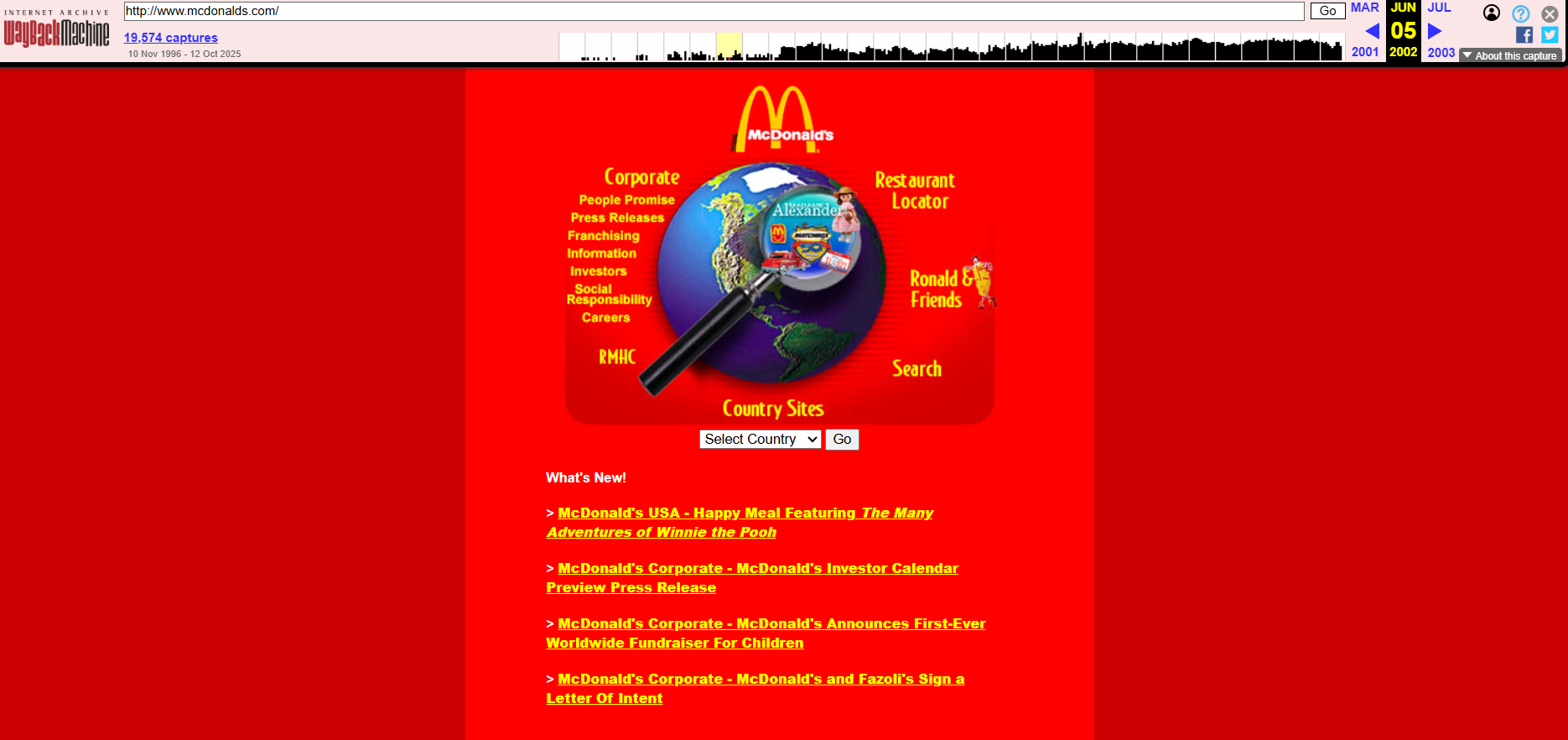
Example of the website http://www.mcdonalds.com/ on 5 June 2002, snapshot by the WaybackMachine.
Web Archives: The OSINT Time Machine
How web archives like the Wayback Machine give us access to deleted or changed web pages to recover critical information.
What are web archives?
Web archives are snapshots of websites taken at different points in time. This allows anyone to access deleted content, trace edits, and compare statements that might have changed. For OSINT enthusiasts, archives are a way to "go back in time."
Web archive tools capture everything from the website: raw content, javascript, css, images, etc. Therefore, the captured website looks exactly the same as when it was captured, even if it was 10 years ago.
The Main Archive Platforms
- Wayback Machine — The largest and most comprehensive archive of the web.
- Archive.today — Less known archive website, captures pages instantly and keeps a permanent snapshot.
- Perma.cc — Used by serious people (mostly journalists and lawyers) for citation preservation.
How to Use Them
If you want to archive a page, simply paste the URL of the page. And if you want to see the potential archives of a page, paste its URL and the platform will show you a timeline of captured versions. You can navigate through these to see how a page evolved.
Example Use Cases
- Revealing freemium content: some websites only show you the first part of content and then ask you to pay to unlock the whole text. Archiving the page might reveal the content that is hidden behind this paywall (it works like a charm with some big websites, don't tell anyone!)
- Recovering deleted content or proving it was there in the first place: press releases, content, public statements, imagery, blog posts, etc.
- Comparing before/after versions of websites.
Limitations
Not all pages are archived. Some websites block crawlers or restrict access. Snapshots can also miss dynamic elements (like javascript-generated data, especially in our modern websites where everything is generated by client-side javascript and API calls).
Even with these limits, archives remain one of the most powerful OSINT tools for digital investigation.
